Deconstructing 5E Classes
I don’t know who the target audience is for this. As much as I do preach the virtues of the play culture surrounding D&D Fifth Edition, it’s with no thanks to the actual ruleset itself; and most others in this sphere don’t seem to care for either. But I had taken a Tumblr poll with my partner to assign D&D races and classes to each member of the Hermitcraft SMP on YouTube, and it got me thinking about how the latter are… messy. I think it was Chris Perkins who had expressed regret that Fifth Edition had twelve instead of just four classes, because the increased granularity meant that the classes were really finely distinguished on the basis of flavor and specialization. These distinctions could have been relegated to the realm of subclasses, but not only did Fifth Edition not do that: it further split each class into three subclasses anyway. That’s thirty-six picks altogether, leading to awkward twins like “paladin but more magicky” and “cleric but more fighty”. Not that having more choices is bad in and of itself, but here it’s subatomically splitting hairs.
I did two k-cluster analyses of classes and their proficiencies: one grouping proficiencies by classes, and the other inverting the same dataset to group classes by proficiencies. The former I had originally wanted to do because I wanted to find macro-skills, almost as if to reconstruct abilities by skills, but then I realized I could also do the latter to find if classes in Fifth Edition are really as structurally samey as they seem. The dataset intersects classes and proficiencies, the latter including skills (boolean yes/no) as well as weapon and armor proficiency (sliding scale: armor is from none to heavy, and weapons are from virtually nil to everything; all normalized within 0–1). Unlike with OSR Rules Families where I showed the incremental splitting of clusters, I’m just going to show you the 4-cluster analyses and describe edge cases textually because the connections are rather stable. I hope this sheds light on expected character archetypes and game roles in Fifth Edition. I’ll definitely find it useful for my homebrew heartbreaker Cinco! which is structured after folk D&D.
Macro-Proficiencies
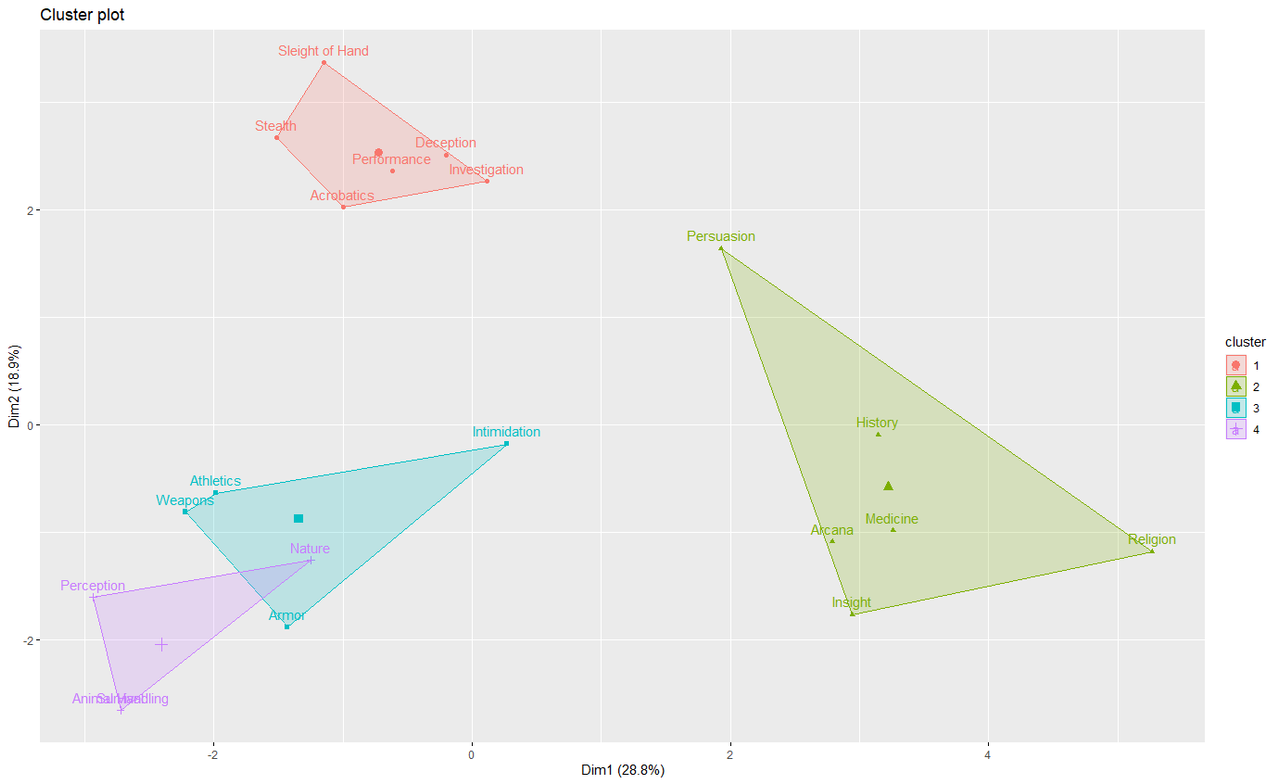
You see what I mean? The splits are super clean. It’d be convenient if the skills clustered according to their ability, and to some extent they do—the groups correspond roughly to intelligence, wisdom, strength (counting weapons and armor as loose strength skills), and dexterity—but you may notice that charisma skills are found between a couple different clusters. The intelligence cluster gets persuasion, the strength cluster gets intimidation, and the dexterity cluster gets both deception and performance (plus investigation, technically an intelligence skill). This provides a double justification for swapping the base ability for intimidation from charisma to strength (and also persuasion from charisma to intelligence): this makes more fictional sense and also aligns with other skills that the same character is likely to have. On the other hand, the extreme overlap of dexterity and skills pertaining to social intrigue make it seem less about physical dexterity per se and more about general chicanery. It probably helps then to think about all these categories in general not as abilities but as (in the same order) nerd shit, hippy shit, jock shit, and uhh theater kid shit.
Some notes. Forming 3 clusters combines the hippy shit and the jock shit, because the most nature-y classes overlap with the most combat-y classes as you’ll see below. Adding a row to represent spellcasting ability seems to shove persuasion into the theater kid box, but I opted to exclude that row because it’s not a proficiency in itself (and is maybe better represented by the arcana and religion skills) and that is literally the only effect it caused on the cluster analysis. Forming 5 clusters interestingly puts persuasion and intimidation into their own box separate from jock shit and theater kid shit, which is cool (they are the non-roguey charisma skills) but less illustrative than them being where they already were. The graph you see is the one I think best expresses the underlying proficiency families of Fifth Edition. Like, you’re probably going to want one character who specializes in skills of each cluster to have a well-rounded party. I also think if you were going to rewrite what abilities characters have in D&D, you’d consider the archetypes represented by this graph to make sure the abilities correlate sensibly with them. I don’t play with standard abilities personally, but this helps me get a feel for how even non-standard abilities should extend into different parts of the game.
Macro-Classes
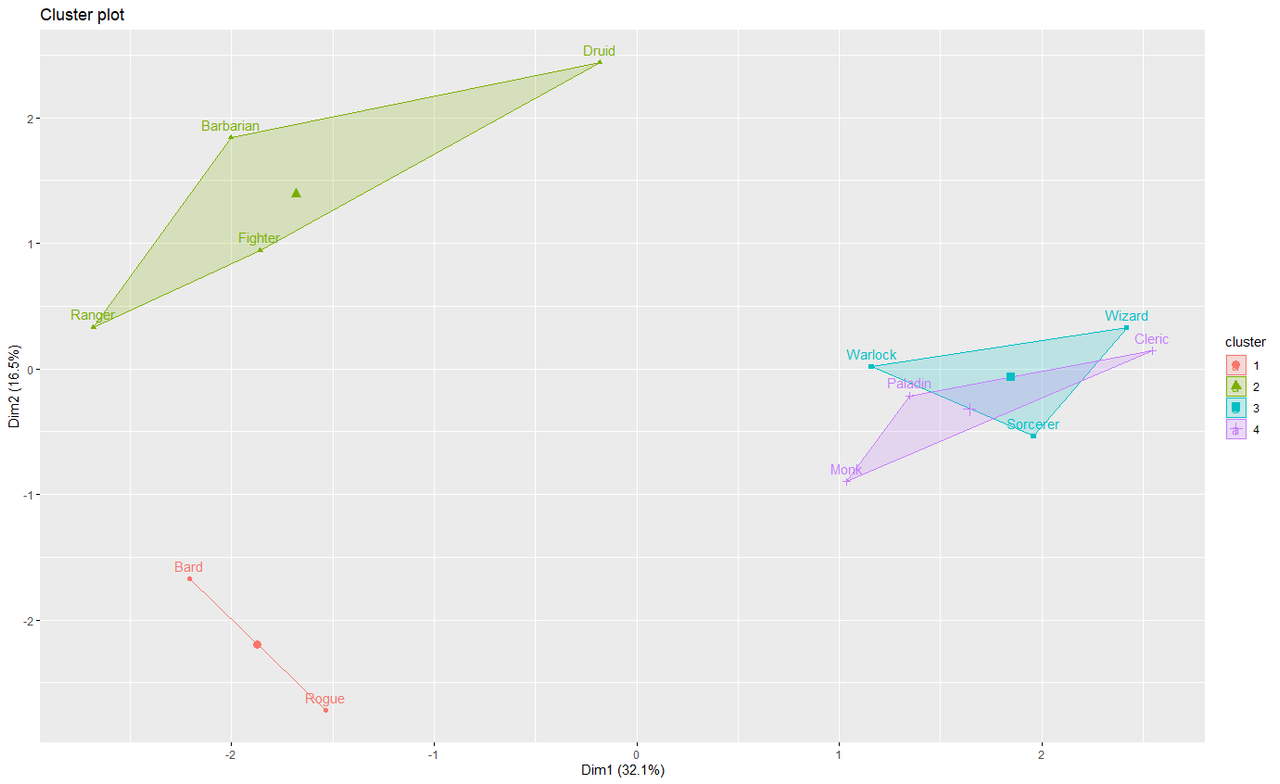
You’ll note that the categories formed by classes are different than the ones formed by proficiencies. The rogue/bard category is non-surprising and matches with the theater kid macro-proficiency from the other graph, but the jock/hippy skills are combined into one group whereas the nerd skills are split into arcane and religious classes. It’s like there are actually 5–6 axes along which characters vary, but they combine into four axes differently when with respect to either proficiencies or classes. This is a good thing! The fact that it’s not all 1:1 means that characters aren’t necessarily meant to put all their proficiency-eggs in one mushy basket.
The categories align roughly with the groups supposed by the D&D 5.5e playtests in 2022 as well as the groups from AD&D Second Edition: mage, priest, expert, and warrior. Though you’ll notice, as far as proficiencies go, our clusters disagree with what class goes where. Rangers and druids both join the ranks of warriors (probably on account of having more weapon/armor proficiency as well as more nature-y skills, making them more similar not only to barbarians and fighters but each other), and monks join the ranks of priests likely just because of their skillset. This isn’t to say that the official groups are wrong, since they also account for class features and party roles that are not clear from proficiencies alone, but I would say rigid categorization is itself suspect. We shouldn’t understand the classes as instances of larger groups, but as combinations of base archetypes which the clusters (both of proficiencies and classes) suggest.
Conclusion
Clustering proficiencies with respect to classes and vice versa suggests only a handful of fundamental functional archetypes within Fifth Edition. Starting from proficiency clusters, we see domains of specialized knowledge, of attunement with nature, of physical might, and of (to speak broadly) sneaky behavior. Clustering classes by proficiency reveals some strong affinity between might and nature, as well as a divide (though one to be expected) between arcane and religious knowledge and practice. Rather than either subdividing or grouping classes by these fundamentals, or (even worse) redesigning classes to focus on just one fundamental, we might better think of them as little building blocks to interface between specific character concepts and common D&D activities. The issue for me then isn’t that classes are messy, but that they obscure their mess and prevent players from making their own.
In other words, I think the premise of each class makes better sense as what character backgrounds currently do, and their proficiencies should be freed from that structure so we can better customize characters to their concepts. What is a paladin but a character with physical might and religious expertise? Aren’t rangers just nature-y fighters, or druids nature-y priests (and of course fucking shapeshifters)? Don’t bards and rogues suggest an underlying thief or charlatan concept, with respect to which bards are more magic-y and rogues are more fight-y? I’d rather have the building blocks than the complete, glued-together set; and I think that’s more in the spirit of what D&D has become.
For my home campaign, I’m going to try broadening the scope of what I’ve called abilities. Rather than being just skills as first-class citizens, I should really boil down the archetypes expected in the game and extrapolate proficiencies from those (though, I think, still keep possibilities open rather than closed/standard).
Here's the dataset if you want to check it out or yell at me!


Comments
Post a Comment