Combat Difficulty Again
I’ve used a bracket system for combat opponents in my home campaign for a while now. It’s been useful to pull stats and moves out of my butt without having to design monsters ahead of time, but sometimes it’s still a bit painful—I won’t extend the metaphor further than it has to go. I don’t like having to refer to the table in my head, and I imagine others wouldn’t like to refer to the table in the book either. The general problem of D&D combat is that ape together strong: many smaller opponents are stronger than one big opponent by virtue of action economy. This is balanced out by bigger opponents not losing strength as they take damage. Still though, you need to know the formula.
And I think I have one? This is super similar to my abstract skirmish rules for OD&D/FMC, except generalized and looking at attack-equivalents rather than granularly modifying the output of one attack ("+1 damage per hit dice of health"). I’ve always found that annoying and kind of obscure. The reason it works is that every ~3.5 hit dice results in ~3.5 damage being added to an attack, which is basically an extra D6 on top of the base D6, in addition to the ~3.5 bonus to the D20 roll. This is a stupid work-around which only works because of the relationship between hit dice and damage dice observed in Muster (my summary of the math below):
[…] monsters deal a quantity of damage that is (sort of) logarithmic compared to their HD. For example, a 4 HD monster deals 2 dice of damage, while an 8 HD monster deals 3 dice of damage. This is a nice convention that aligns neatly with what we expect from monsters of these levels, but it relates less to OD&D than to how it interfaces with Chainmail.
Lmao. Well how’s this, bitch? For each time you halve an attack’s D20 bonus, which we can assume is based on their hit dice or equivalent, multiply their damage output by +1. For example, if a monster gets +8 to hit, they can use +4 instead for +1 damage factor or +2 for +2 damage factors. For OD&D that means +1D6 or +2D6 respectively. For Cinco! that just means +1 or +2 damage, since I measure health in discrete hearts.
This means I don’t need to define opponents in brackets by powers of four HD (or hearts) anymore. If a monster has 10 HD or hearts, I can use their bonus at +10 for a basic attack or halve to +5 for a doubly powerful attack, or +2 (round down) for a triply powerful one. Since I also cap bonuses at +8 in my own campaign, this also necessitates that opponents of difficulty 9+ must either enhance or split their attacks.
Quick example: compare two 4H (HD/hearts) opponents with one 8H opponent, assume that the party can deal 4H damage/turn. The two 4H opponents (by my rules) each deal ~1 damage/turn, and thus initially deal ~2 damage; while the 8H opponent can only deal 1.4 damage. However, it’s likely that one of the two 4H opponents will go down that turn, meaning the last one will only deal 1H damage on its own. That’s an average of 1.5H, just about approximate to the 8H opponent! Additionally, as described, the 8H opponent can halve their attack bonus to deal +1H damage on a hit; that’s ~1.75H per attack, which is alright with me since there’s a more significant chance of missing (+20%).
I guess you could also subtract 4 instead of halving? Especially if one doesn’t intend for opponents of difficulty 3-- to do this. But I’d like to have other attack enhancements like attacking at range or within an area of effect, and I want to make sense of big opponents whose H may exceed even 16 (at which point subtracting 4 does nothing). Would rather just cap how much max damage an opponent can deal. Now I can use the table below directly.
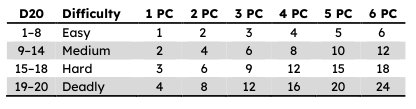
I don't know. That's nice. I can even move points between hearts and ability. Will give this a try soon! I guess this also assumes that rolling 20+ adds another damage factor unto itself so uh keep that in mind.


Comments
Post a Comment