Resourciv v0.5: Great Leap Forward
That's right. Naming this update for the Big Man himself because it's just that big. I almost considered naming it instead for one of my favorite tween boy-bands-slash-reality-television-shows, Big Time Rush, and the episode centered on their song Halfway There, because (let's see if I remember it correctly) we're almost kinda sorta close to being halfway there. Check out the widget below to download the game or visit the Itch page, or keep reading to learn about what I have in store after months of constant deliberation and anal-retentive bullshit.
Economy
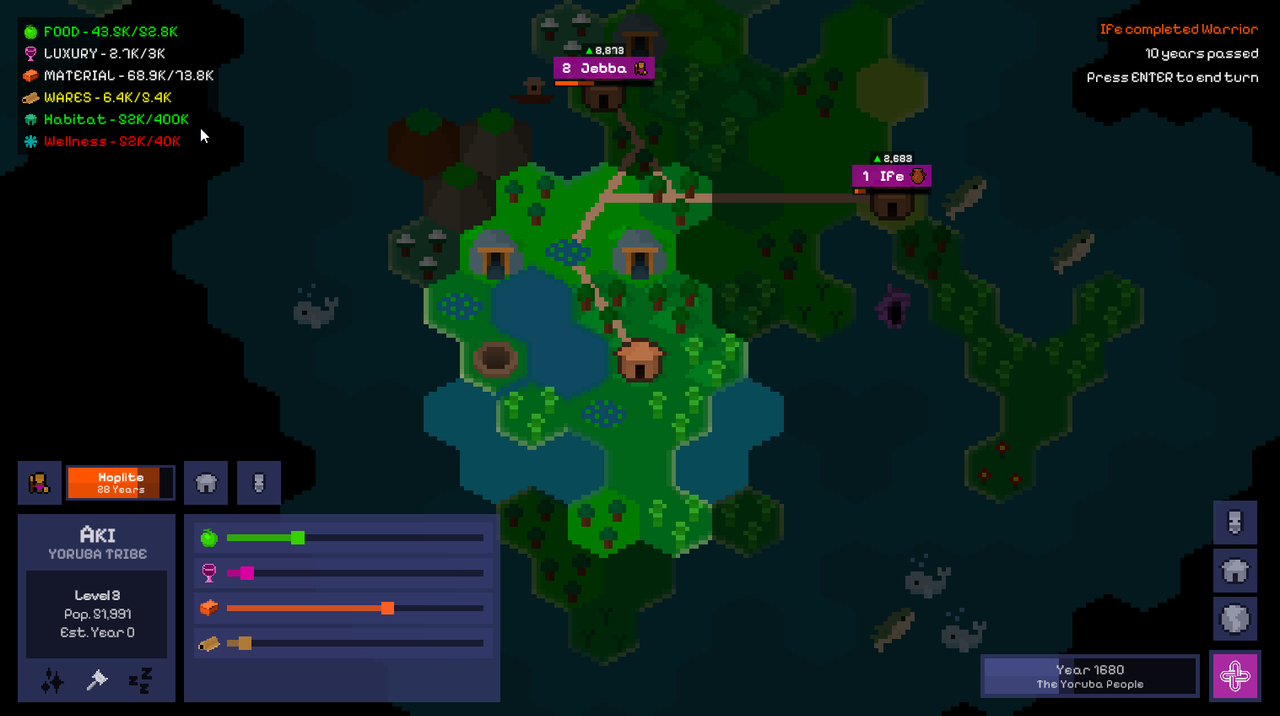
Good-bye to markets where granular goods meet granular needs. The angels revealed to me a new approach to economic simulation, one which sounds similar to how I had once envisioned this game would function much earlier on. Output yields are back and simple. You can allocate percents of a population in each city to each yield, using Cobb-Douglas to determine how much is generated each turn, but labor is not the only factor. Nature’s bounty serves as your basic pool of capital for each yield. Just like before, yields represent through-puts, rather than accumulative stockpiles for which you need to constantly tear down your barns (my least favorite part of this genre). Building features on the hex map or discovering technologies can help a city better exploit resources, by either increasing bang for your buck or unlocking new effects altogether.
The first two yields you have to worry about are Food and Material. As your population increases, you need to start generating Commerce to keep goods flowing and Wares to support your people’s needs (or, unlock Patriarchy so wives do the heavy lifting). Around then your population may ascend to statehood, at which point you need to also generate Luxuries to keep your noble class happy. I guess that brings us to…
Demographics
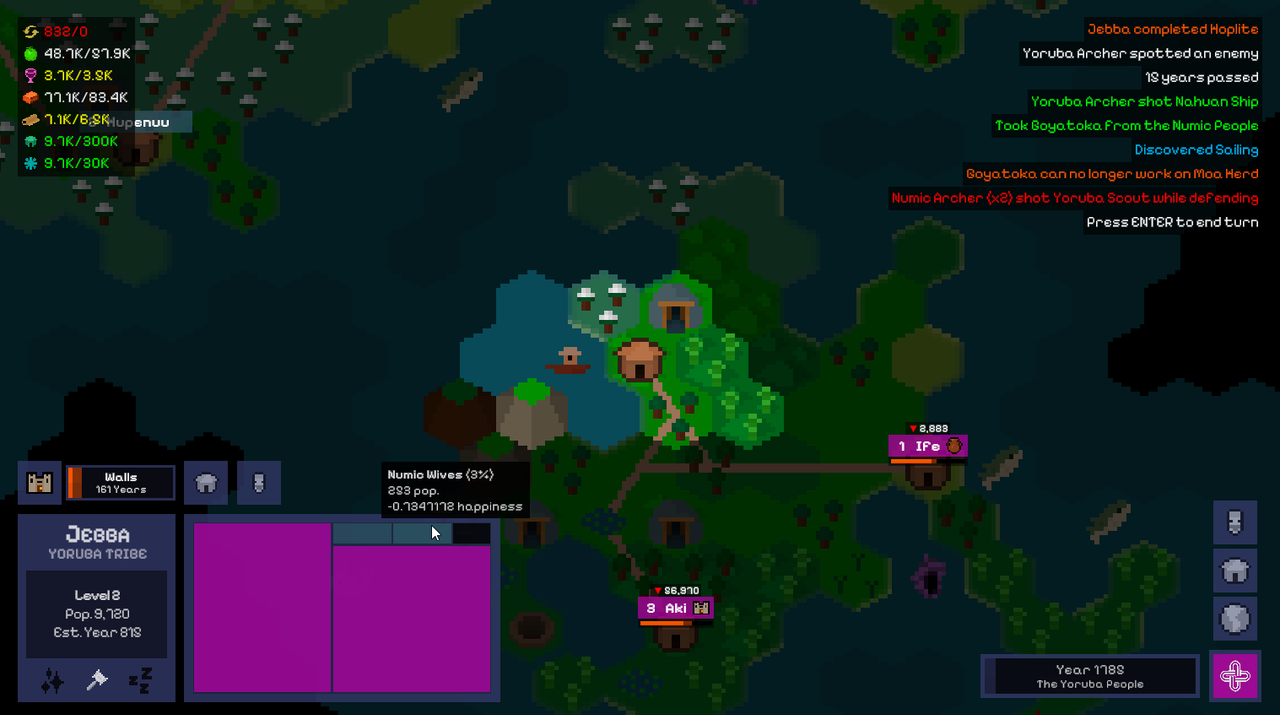
LISTEN HERE. PAY ATTENTION. I CHANGED MY MIND. Discrete peeps were a fun idea but one that prevented me from doing cool shit with demographic composition, so I went the opposite way: lean fully into realistic populations which shift and change according to well-understood ecological principles, like logistic growth and Liebig’s Law, and which are divided into dynamic social classes (here called “strata”, because “class” is unfortunately a restricted word in my programming language of choice). Each stratum has a weight which determines its ideal slice of society, and each culture has a discrimination score which can softly prevent it from entering higher strata (if the culture is not forced into actual slavery and prevented from entering any normal strata whatsoever). Each intersection of society along the axes of culture and stratum has a population size which grows according to how its needs were met, and a clout score based on its cultural discrimination, stratum status, and overall size which measures its sway over public discourse. They also may have their own needs, like nobles wanting luxuries. Though each intersection grows independently, a city reshuffles its entire population each turn to meet socially-imposed quotas. Unless the country has entered liberalism or communism, for example, a decrease in the number of nobles from “starvation” (more like, a loss of treats) means other pops will fill the void. Obviously, needs which impact everyone are more deadly, especially Food.
Map Generation
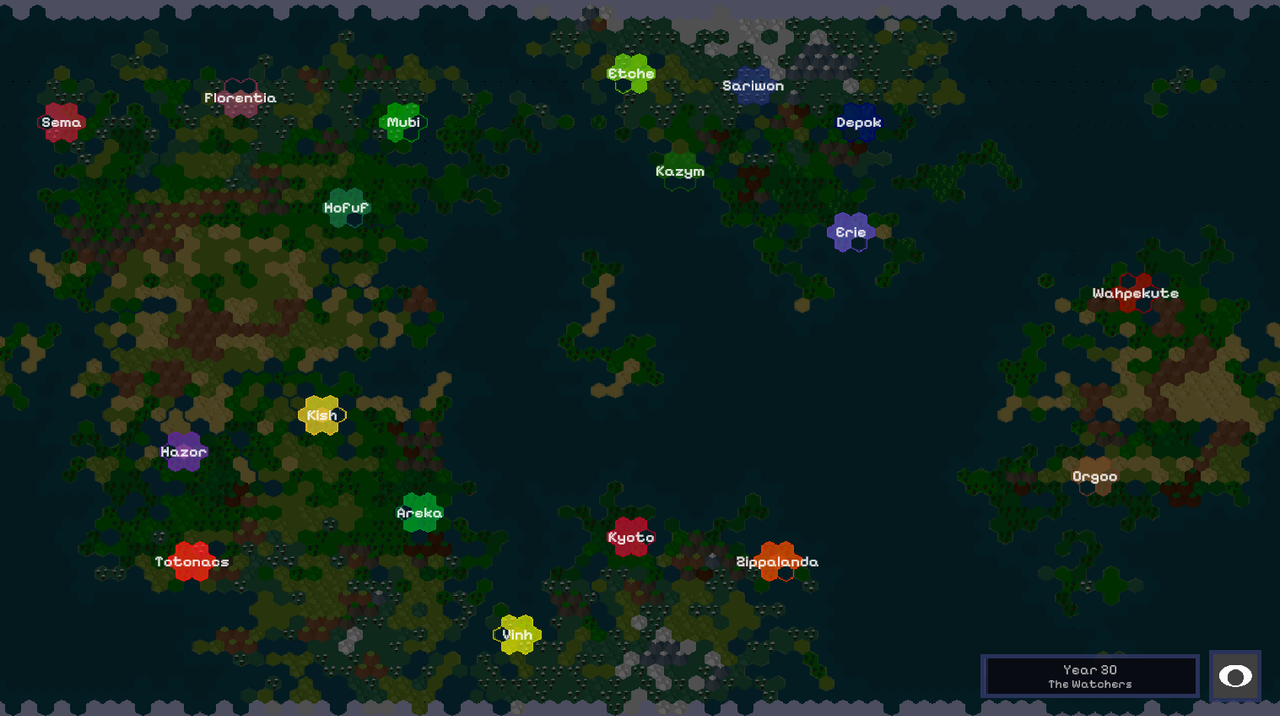
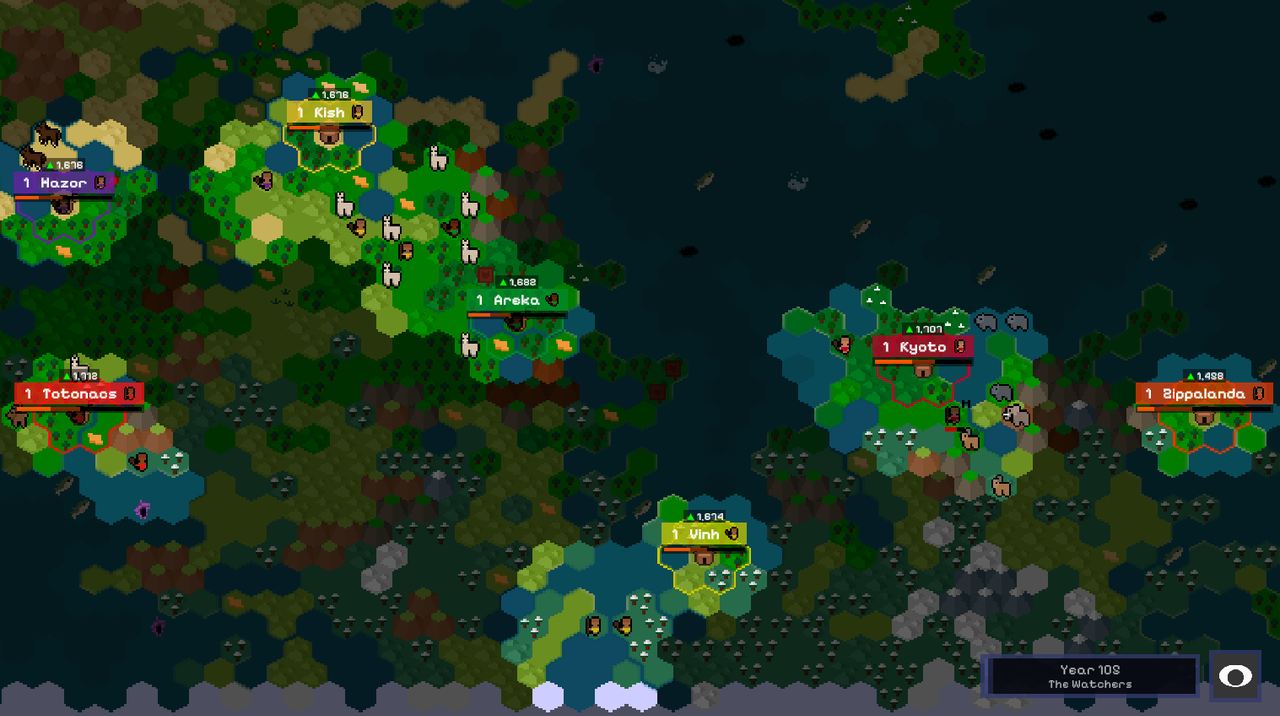
I optimized the shit out of map generation, especially rivers, and improved the creation of landmasses in a way which makes it faster and more interesting. I also added continents—not the same as landmasses per se, but more like assignments of different sets of animals and resources to spawn in different regions of the map. Originally I had Africa, America, Asia, and Europe, but I panicked because I forgot about fucking Oceania whose animals are all kind of fucked up and I was like oughhhh. But anyway, lots of cutesy animals now! Elephants, hippos, capybaras, goats—and my best attempt at moas and kangaroos so far. And more! I’m still fleshing this out, but I hope the map variety feels nice.
Modding
I made most of my game rules and dialogs and sprites programmatic and serializable. Just drop a folder modeled after /StreamingAssets inside the mods directory so you can load them inside the game, as well as prioritize them. Loading a game that was played with mods will cause those same mods to be reloaded automatically, provided that they’re still available (though I don't know how this will respond to massive differences in cached versus current game rules/assets). At some point, I want to support map-making, and that will probably be handled this same way.
And More!
CPU-controlled teams now actively engage in diplomacy! They'll make friend requests and declare war on you and each other. Different cultures now have different skin colors, and this too is moddable, whether you want to switch out skin colors or define new ones altogether). Building walls gives your city a layer of defense which must be breached before its garrison can be fought or the city itself can be taken. Pops will demand policies to be implemented, and will either celebrate upon your doing so or will be rather upset if you don't. Most urban buildings, in fact, have been converted to "upgrades" internal of the city itself; my plan later is to have significant modern things like suburbs and factories be represented on separate hexes, but otherwise buildings will be "stacked" in the city itself. There's some gaps in gameplay and dialog, but the skeleton is overall much more fleshed out than it previously was—and I find myself playing little campaigns for one or two hours every day. I hope you also enjoy this update. Thank you for following along!


Are you modelling carrying capacity? While the term has been deployed in problematic ways in the past, years ago it led me to design an assignment that modelled the interaction of top soil loss, grazers, and changes in soil accumulation. It is a simple model, but it would possibly be a way to capture agriculture's impact on long-term carrying capacity in a game. I will click notify me, and if you are interested, let me know and I'll figure out how to send you the instructions.
ReplyDeletewith respect to population growth, sort of! rather than having a hard ceiling, growth is limited by the lowest-met need (e.g. food or housing, the latter being determined initially by access to water): meaning that if a lowest met need is 100% (i.e., 0% surplus), no growth occurs, and starvation occurs at less than 80% met (bit of a buffer between 81% and 100%).
Deletei would be very interested in modeling soil loss and desertification! my only concern has been it being too complicated, since i don't know if/how i can track states on a per-tile basis. but if you have a model i'd be really interested in seeing it! :) thank you for reaching out