Weapons: An Informal Review
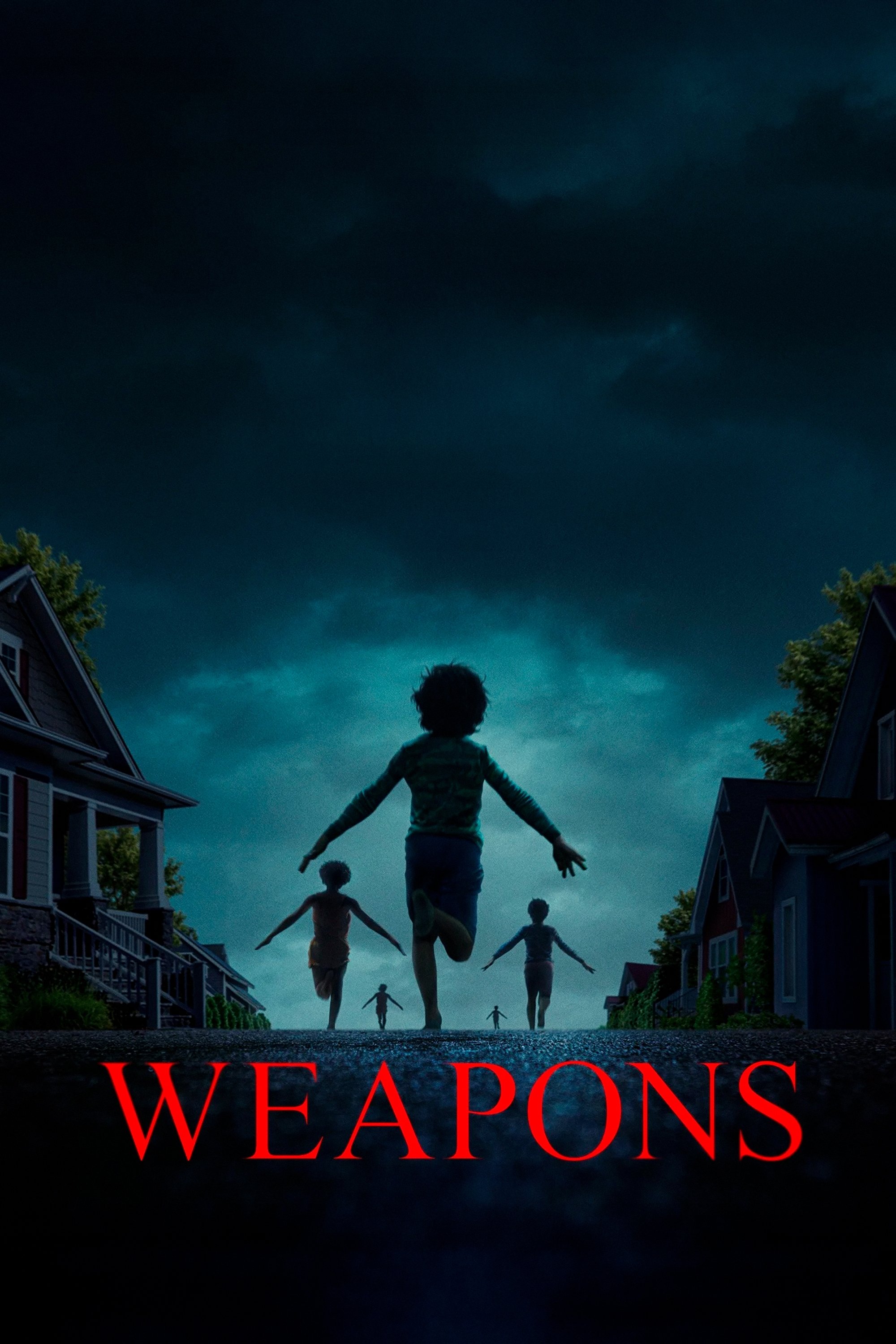
I’m considering this post to have been co-authored by my partner. She had seen the movie closer to when it had come out, and she told me it quite frustrated her because it felt like a movie gesturing towards a big statement—about school shootings in particular—without actually committing to a statement and doing something totally different instead by the end of it. All I had heard was that it involved children being turned into actual voudon-style zombies, and was surprised that what I thought was part and parcel with its premise was more like a twist out of left field. She didn’t spoil the whole thing in case I wanted to watch it later, but it took me a while because I am not super into horror movies (I would say except that now since horror has become the statement genre, but…), and I only just got around to it this weekend. Oh boy.
So, it’s certainly trying to gesture towards school shootings, right? The narrator’s opening monologue clearly evokes the community trauma of a classroom’s worth of kids all being lost (bar one), how the blame falls unfairly on teachers for either not doing enough, how complacent police silently give up on delivering justice, and how eventually we all decide to act like nothing happened so we can get on with life as normal. It’s barely subtext. But the lone child who seems to survive the event, as my partner pointed out to me, is framed variously as a suspect in his classmates’ disappearance (i.e. as the school shooter) or as a beneficiary of blind fate. His cop-fucking teacher, who is being hounded by angry parents, nevertheless worries for the child and asks the principal to meet with his parents to see how he’s coping.

And this is where it all gets kinda stupid. Instead of his parents, a kooky old woman who claims to be his mom’s aunt visits the school, and says his parents are feeling unwell and couldn’t make it to the meeting. The principal politely dismisses her because she isn’t the kid’s actual legal guardian, but then she follows him home, reveals her voudon magic shit, and turns him into a zombie whom she sends off to kill the teacher after compelling him smash his husband’s head to death with his own head. Grisly. The teacher and one of the missing children’s dad deal with the zombie principal, realize that the surviving kid’s house is where all the missing children are, and then have a big fight with the teacher-fucking cop and a junkie who were turned into zombies during a B plot (the cop does a hecking police brutality, the junkie says he knows where the missing children are, then they both end up trapped in there). Eventually they turn the aunt’s magic against herself and all the zombified children maul her to death. And then they’re de-zombified.
As I summarized the movie above in those two paragraphs, I realize why my partner said she felt like Weapons was like two different (and incomplete) movies smushed together—one half is a heavy-handed allegory about school shootings, and the other half is a weird magical realist tale. It’s not that the two halves are necessarily incompatible, whether with respect to plot or theme, but they were not integrated thoughtfully or cohesively, and so the movie in toto feels like a confused mess. One hopeful interpretation published on The Verge suggests the movie is about “communities [conjuring] convenient boogeymen”, but even though some of the parents blame the teacher, the tendency of community leaders in the movie is to shove the incident under the rug despite increasingly obvious evidence of an actual fucking boogeyman. The text is happy to lay blame for this mysterious event at the feet of a mysterious outsider masquerading as a community member. The director himself suggests the second half [!] is autobiographical about his own experience growing up with parents afflicted by addiction, the feeling of one’s own parents becoming zombies that you have to take of yourself. But that casts a strange light not only on the first half of the movie which is explicitly suggestive of school shootings, but on the survivor child who is revealed to actually be complicit in the disappearance of his classmates. It’s almost as if to suggest that school shooters are the product of familial and social abandonment, and they are thus equally or more sympathetic as victims than the children who were actually killed (or in this case, zombified)—but even if one can argue that, it still absolves the child of his decisions and finds their locus outside his own relations. Meanwhile, my partner points out how little time is spent interrogating the horror of being made into a zombie. We just are supposed to feel sorry for the one kid who feels so bad that his parents and classmates were zombified, the latter by his own actions. Boo-hoo.

Weapons is also a very white movie. The only speaking non-white character is the school principal (who is also gay, if that sweetens the pot) played by Benedict Wong. There were apparently a handful of zombified school children who were black? Anyway. I don’t mean this in a way where it’s like, the movie should have been less white, but more like it both is so conspicuously white and also keeps gesturing towards deeply racialized topics such as police brutality and voudon—and especially zombies whose bodies are wielded against their own wishes, encoding a historically specific anxiety about chattel slavery. Even the villain character is an old white woman who, while in the comfort of her home (or that of the child’s parents whom she zombifies), dresses like a stereotypical Haitian woman. Now I don’t think the villain should’ve been black. It makes sense for her to be white given the context of the original zombie myth. But I think the movie would’ve been more cohesive if the community at large were non-white—except, perhaps, for the school administration and police department who don’t value the missing children enough to investigate them, or trust the old white lady and her apparent grand-nephew too much to suspect them of any wrongdoing. I think she even has the zombies do fucking housework for her and shit? But by literally whitewashing the racialized topics it clearly wants to make a statement on, it compromises its ability to comment on those topics at all.
My partner diagnoses a lot of poor art as suffering from artists leveraging common, and often obvious, symbols of certain feelings and experiences, sometimes from other works. But they mistake the shorthand or reference for actually making their own statement and thus avoid developing their own system of meaning. Likewise Weapons, ironically enough, weaponizes school shootings and police brutality and voudon in the service of curating a spooky-oopy vibe with a conscious veneer, while intentionally or unintentionally avoiding the work of submitting a statement on any of those topics. You can absolutely make a film about all three of those things, but Weapons is not about any of them despite its gestures. When it raises questions about those topics, it’s not because it offers a new perspective from which to consider them, but because it invokes and combines them in strange ways. My partner compared it to a garden-path sentence, in that it technically is a whole story, but it is constantly compromised by what it does and what one would expect at any part of the story. Agh! Not a bad movie. Just frustrating.


Comments
Post a Comment